Frequently Asked Questions
Baker's Numbers : Can you explain ?
~~~~~~~~~~~~~~~~~~~~~~~~~~~~~~~~~~~~~~~~~~~~~~~~~~~~~~~~~~~~~~~~~~~~~~
Fortified flour : What are they ?
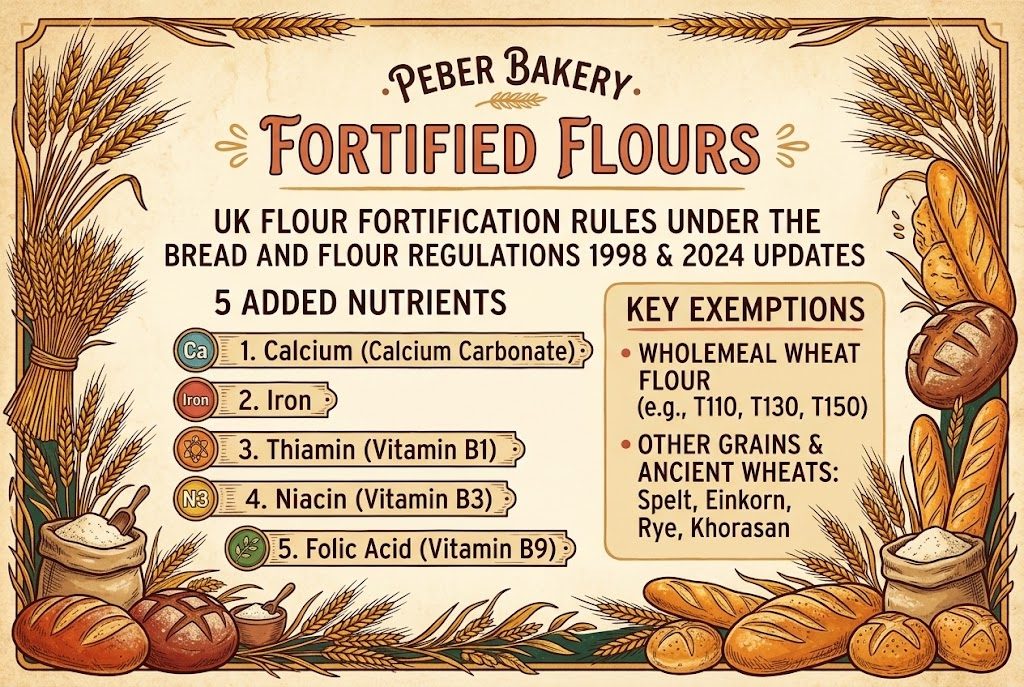
It is flour that has had essential vitamins and minerals added to it to improve its nutritional value and help address public health concerns. In many countries, including the UK and the US, laws require certain nutrients like iron, calcium, and B vitamins (thiamine and niacin) to be added to white and brown flour to prevent deficiencies in the population in order to be able to be imported. Our supplier is not exempt.
What fortification means
Adding nutrients:
Fortification is the process of adding micronutrients, such as vitamins and minerals, to a food.
Boosting nutrition:
It can either replace nutrients lost during processing or add nutrients that were not originally present to enhance the food's nutritional quality.
Public health measure:
Fortification is a cost-effective way to improve the health of a population by preventing widespread nutrient deficiencies, such as anaemia or neural tube defects.
Common nutrients in fortified flour
- Iron: To help prevent iron-deficiency anaemia.
- Calcium: To support bone health.
- Thiamine (Vitamin B1): To prevent conditions like beriberi.
- Niacin (Vitamin B3): To prevent conditions like pellagra.
- Folic acid (Vitamin B9): Increasingly added, especially in countries like the UK, to reduce the risk of neural tube defects in unborn babies. To our knowledge Folic Acid is not included in the compulsory range of fortified additions in our flours. However check carefully all the terminology which can be in latin in the pdf ingredients of our flours.
Why some flour isn't fortified
- Wholemeal flour:
In some regions, wholemeal flour is exempt from mandatory fortification because the natural bran and germ already contain high levels of vitamins and minerals.
Other flours:
Some special flours, such as certain self-raising flours, may also be exempt from fortification requirements.
~~~~~~~~~~~~~~~~~~~~~~~~~~~~~~~~~~~~~~~~~~~~~~~~~~~~~~~~~~~~~~~~~~~~~~
What type of bread does Peber produce using the different mixes ?
Peber uses precise mix weighted always to a gram precision, to craft artisanal sourdough breads inspired by French baking traditions. The specific type of bread varies depending on the chosen flour proportions and the baker's expertise. See the breads on offer please available to purchase by trade and consumers on site at Scorrier.
Our baked bread have a life of 1 day for the baguette / flute, 3 days for most of smaller laoves, 4 for the large and 5 for the Rye and Pumpernickel. This one good consequence of using only sourdough mother starter and not yeast added to save time, but reducing health benefits and longevity of cunsumption.
- Sourdough bread refers to bread that has been leavened naturally using a fermented mixture of flour and water containing wild yeast and bacteria (a "sourdough starter"), rather than commercial baker's yeast. This traditional, slow fermentation process gives it a distinct tangy flavour, chewy texture, and potential health benefits (e.g., improved digestibility).
- "No Bread with sourdough" could refer to regular, commercially yeast-leavened bread that has had some sourdough flavourings or a small amount of dried sourdough powder added to it for taste, without undergoing the authentic, slow fermentation process. This is sometimes referred to as "sourfaux" and does not offer the same characteristics or health benefits as true sourdough bread. Peber does not make this type of bread
What is the composition of the flour mix?
The blend consists entirely of wheat flours—ranging from one to three types—selected and combined in variable proportions based on traditional French methods and the baker’s experience. Learn more about our flour varieties [here].
What is the recommended recipe using this mix with innoculation of our starters ?
To make 1 kg of dough, we recommend the following proportions that can varry slightly mainly for hydration according to the bread made :
- 498 g of our flour mix
- 174 g of white sourdough starter
- 323 g of warm water
- 5 g of sea salt
Please refer to our detailed preparation instructions [here]. Please note that we use 3 types of home made starter, used each for specific bread although you can use a different kind of mother starter used as all are protable to any flours:
- White starter : used for Deli, Baguettes, Fougasses, Saffron bread , The Ancient and Pixies
- Rye Starter : Used for Rye bread, Pain complet and Pizza
What is your delivery lead time?
We only deliver ourselves in our vicinity and within around 3 miles from base. However we use Fedex for Nationwide delivery for £8.95 / drop up to 25 kg and effective delivery before noon 12 pm next day.
We dispatch orders the next working day from Monday to Thursday. Preparation requires 48 hours to ensure the sourdough starter is optimally refreshed on the day of collection. The starter is shipped under refrigeration and should be kept at approximately 4°C upon receipt and after its next refresh. For additional guidance, see our storage advice [here].
What is the approximate cost of a finished loaf or cob?
Due to dough hydration, the cost of flour per loaf is effectively practily halved based on our selling prices. Please note that approximately 15% of the dough’s weight is lost during baking. You should also account for a proportionate cost of the sourdough starter when calculating total production costs.
Are discounts available for bulk purchases?
Yes, we offer trade discounts for hospitality and retail clients. Significant savings are available when purchasing by pallet of 750 kg, or 60 bags of 25 kg and blending your own mix following our guidelines. Please contact us with your company name and address to receive a tailored offer, once you’re satisfied of our quality of baked lines etc .
Am I required to use your sourdough starter while I buy your flours ?
Not at all. You are welcome to use your own starter, or even opt for a yeast-based bread using only our flour. However, please note that we do not offer technical support for yeast-based baking, as it falls outside our artisanal expertise and ethic.
Sourdough or Sourfaux ?
Sourdough is the type of bread, Bread is the food itself. So, just like you would say "wheat bread," "white bread," you say sourdough bread. If you use "with," you would usually be talking about an ingredient inside or alongside something else (like "bread with raisins") as the loaf itself, it's always sourdough bread.
In the baking industry, using commercial yeast (baker's yeast) in a loaf labelled as "sourdough" is the primary way consumers are deceived. Food consumer groups actually have a nickname for this: "Sourfaux."
Here is how the deception works, why industrial bakeries do it, and how to spot it.
- The Sourdough Illusion : Authentic, traditional sourdough requires only three ingredients: flour, water, and salt. It relies entirely on a "starter"—a live culture of wild yeast and beneficial lactic acid bacteria captured from the environment. This natural fermentation process is slow, often taking 12 to 48 hours.
Industrial bakeries want the high price tag and healthy reputation of sourdough, but they don't want to wait 24 hours for bread to rise. To cut corners, they use commercial yeast as a deceptive shortcut.
- Why Adding Yeast is Deceptive : When commercial yeast is added, it forces the bread to rise rapidly. Because the dough rises in a fraction of the time, the biological magic of sourdough never happens:
- Bacteria don't have time creating real flavour, so manufacturers have to inject artificial flavourings or acids to mimic the "tang."
- The gluten and starches are never broken down, meaning people who buy sourdough because it is easier on their stomachs end up bloated and disappointed.
Because many countries do not have a strict legal definition for the word "sourdough," big supermarkets and commercial brands exploit this loophole. They use a tiny splash of inactive sourdough powder for labelling purposes but use commercial yeast to do all the actual heavy lifting.
How to Spot the Deception : The easiest way to avoid being tricked is to flip the loaf over and look at the ingredient list.
The Golden Rule: If you see the words "yeast," "baker's yeast," "ascorbic acid," or "vinegar" on a sourdough label, you are looking at a hybrid loaf or a fake. Real sourdough will only list flour, water, salt, and "sourdough culture" or "starter."
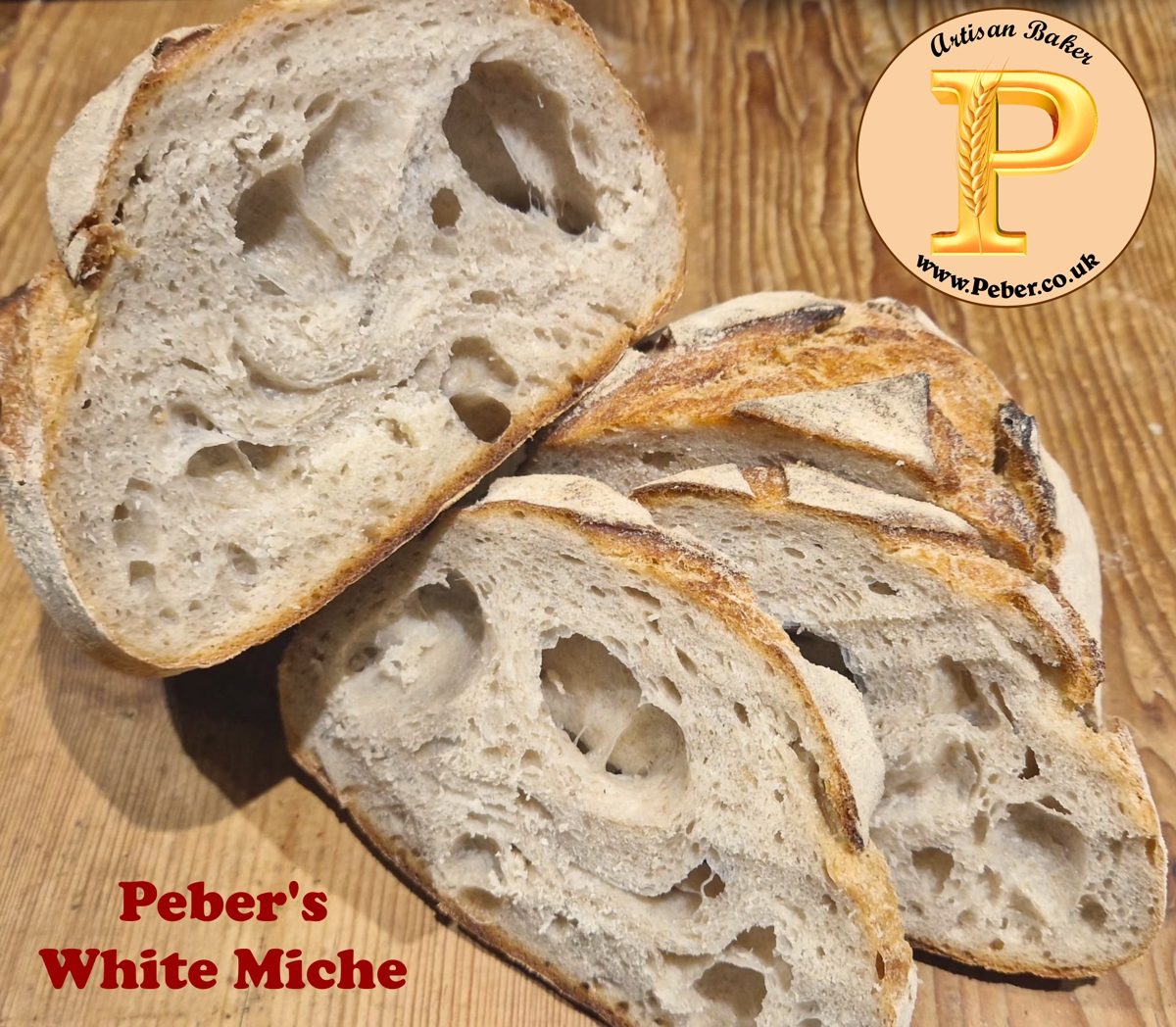
Are the holes different between real sourdough and faux ? The holes are usually completely different. In the baking world, the pattern of holes inside a loaf is called the "crumb structure," and it is one of the easiest visual ways to spot a fake.
Real Sourdough: Irregular & Wild : Because wild yeast and lactic acid bacteria ferment at different speeds and produce gases naturally over many hours, real sourdough has an open, irregular crumb.
The Hole Pattern: You will see a chaotic mix of big, medium, and tiny bubbles scattered randomly throughout the slice.
The Texture: The walls of the holes look slightly glossy or translucent (bakers call this a "gelatinized starch" look), which gives the bread its distinct, bouncy chew.
Faux Sourdough: Uniform & Pillowy : Commercial baker's yeast works incredibly fast and aggressively. It pumps out gas perfectly evenly, resulting in a closed, uniform crumb.
- The Hole Pattern: The holes are tiny, highly consistent, and look like a sponge or a honeycomb. If every single hole is the exact same microscopic size, it was almost certainly made with commercial yeast.
- The Texture: The interior feels soft, uniform, and "pillowy" rather than chewy. It handles like standard sandwich bread because, biologically, that is exactly what it is.
The Exception to the Rule : Be aware of one clever industry trick: some mass-manufacturers use high-speed machinery to deliberately inject or trap large pockets of air into the dough right before baking. This mimics the "big holes" of real sourdough.
However, you can still catch them. If a loaf has a couple of giant, artificially trapped holes but the rest of the bread looks like a fine, tight sponge, it's still a fake. Real sourdough has a natural gradient of all bubble sizes working together.
Hi Peber : What is your due diligence linked with roasting chicken ?
Peber under HACCP (Hazard Analysis Critical Control Point) knows that poultry preparation is a high-risk area and recording critical control points (CCPs) is a must
Traceability: Peber uses only quality Red Tractor chickens, delivered with 7 days Use By date by an approved British supplier. Peber is retaining invoices/batch numbers and temperature of the birds at time of delivery following probing
Temperature Logs: Peber is keeping written records of core probe temperatures for every batch roasted always over 75°C after 30 seconds Standard probe threshold, while probes are sanitised at every use
Temperature Control
Under the Food Safety and Hygiene Regulations, legal threshold requirements guidelines followed by Peber are :
- UK Danger Zone: 8°C to 63°C. as bacteria multiply rapidly within this range.
- All our batches are roasting chicken from 11.00 am daily. The birds are usually ready to serve and eat shortly before 1 pm. At this stage the rotisserie oven is lowered in temperature to about 70°C until 3.00 pm keeping roasted chicken hot holding for service until they are refrigerated .
- Cold Storage: Refrigeration will be kept at or below 5°C.
- Cooling: Cooked chicken will be cooled from 63°C to below 8°C within 2 hours maximum, before placing in refrigeration.
- Reheating & Leftovers: Peber’s Roasted chicken will be sold to eaten within 48 hours (or frozen) and reheating only once to a minimum of 75°C as part of a ready meal using Chicken .
~~~~~~~~~~~~~~~~~~~~~~~~~~~~~~~~~~~~~~~~~~~~~~~~~~~~~~~~~~~~~~~~~~~~~~~